ELC
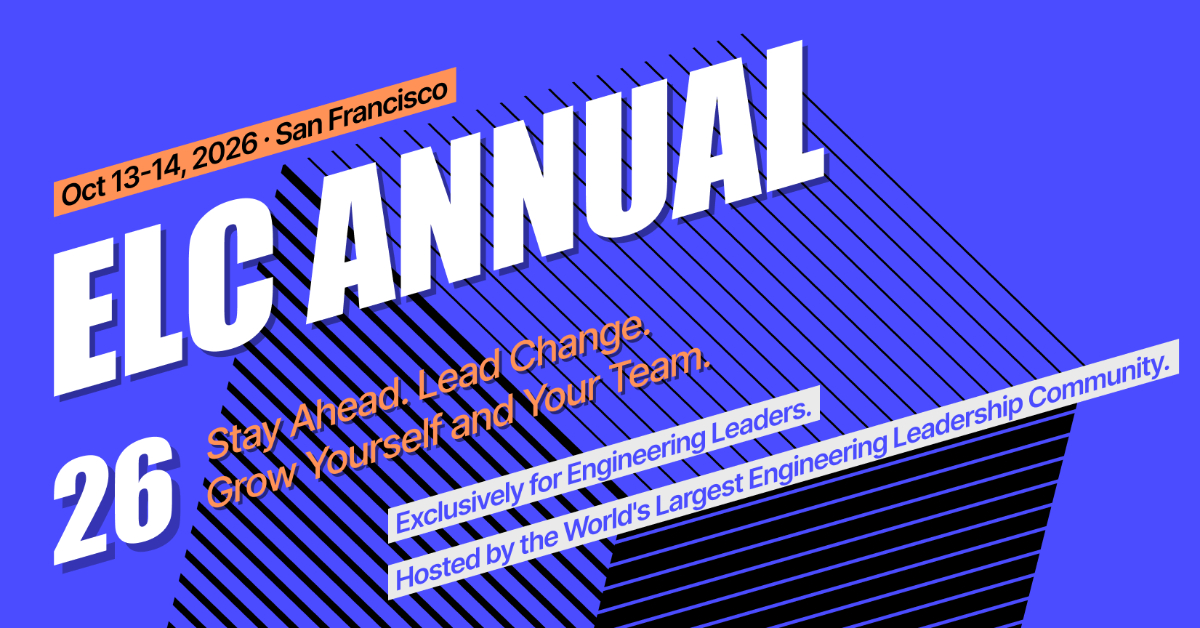
ELC Annual 2026
Location
IN-PERSON
8:00 AM PDT
(Event time zone)
Oct 13 – Oct 14, 2026

ELC Annual 2026

# ELC Annual 2026
# Leadership
# Roundtable
# Public Speaking
# Career
# Collaboration
# Org Design
The ELC Annual is built around a simple belief: the most valuable learning happens in conversation - with peers who are navigating the same pressures, making the same hard calls, and building through the same uncertainty.
This year, we're going deeper on the questions that don't have easy answers.
What does it mean to lead well when the ground keeps shifting? How do you build teams that are resilient, high-trust, and genuinely high-performing, not just on paper? What does great engineering leadership look like beyond the technical, in the moments that require judgment, integrity, and clarity of purpose?
Across roundtable discussions, intimate speaking sessions, and 1:1 conversations, you'll engage with engineering leaders who are thinking seriously about these questions — and willing to share what they've actually learned.
—
What you'll explore
  • Leadership & Strategy
Leading through uncertainty and volatile decision-making environments. The evolving CTO/VP role — from roadmap owner to visionary strategist. Ethical decision-making, leadership integrity, and purpose-driven organizations. Storytelling and influence: communicating complex ideas to executives and boards.
  • Teams & Culture
Building high-trust teams and psychological safety at scale. Navigating culture shifts in growing organizations. Scaling hybrid and remote work — the practices and rituals that actually stick. Building inclusive engineering cultures and diverse talent pipelines.
  • Talent & People Development
Developing next-generation leaders through mentoring and succession planning. Continuous performance management and feedback systems. Retention, engagement, and creating environments where people genuinely thrive. Hiring for potential: assessing soft skills and growth mindset.
  • Cross-Functional Collaboration
Aligning engineering, product, and design around shared outcomes. Breaking down silos with tools and practices that work. Customer-centric engineering: building products users truly love. Cross-functional OKRs and collaborative planning across roadmaps and backlogs.
  • AI in Practice
Building AI-enabled teams — what it looks like beyond the theory. AI in software development: coding assistants, prompt engineering, and human-AI collaboration. Translating AI trends into actionable engineering strategy. Architecting AI systems that make it to production and stay there.
  • Engineering Excellence
Measuring developer productivity, satisfaction, and team health. Observability and incident response in AI-enabled systems. Balancing innovation with operational priorities. Coaching teams through change without losing momentum.
—
What to expect
Roundtable Discussions
Small-group sessions facilitated by experienced practitioners — designed for active participation, not passive listening. These are the conversations where people say what they actually think.
Speaking Sessions
Close-up conversations with engineering leaders who are actively shaping what the role looks like today. Past speakers have included leaders from OpenAI, Stripe, Google, Dropbox, Atlassian, and Slack, as well as Reid Hoffman, Max Levchin, and Adam Grant.
1:1 Meetings
Structured time to connect directly with peers, mentors, and industry veterans. Some of the most valuable relationships in ELC have started here.
—
Leave with a clearer sense of what kind of leader you want to be - and a network of people who are working toward the same thing.


Speakers

Nancy Wang
Chief Technology Officer @ 1Password
Sagnik Nandy
CTO @ Docusign
James Everingham
CEO @ Guild.ai
Ben Kus
CTO @ Box
Monica Bajaj
CTO & SVP @ Okta
Katelyn Lesse
Head of Platform Engineering @ Anthropic
Benny Chen
Co-founder @ Fireworks AI
Amir Haghighat
Co-founder @ Baseten
Tom Adams
CTO @ Adyen
Catherine Ye
SVP of Engineering @ Adyen
Rukmini Reddy
SVP of Engineering @ PagerDuty
Ananya Helmich
VP Engineering, Search, AI, Machine Learning @ Slack
Hari Lingamagunta
VP and Head of Dev Infra @ Atlassian
Zohar Einy
CEO @ Port.io
Wade Chambers
Chief Engineering Officer @ Amplitude
Geddes Munson
SVP Engineering @ Affirm
Scott Woody
CEO and Co-founder @ Metronome
Michael Grinich
CEO & Founder @ WorkOS
Chris Chiu
VP of Engineering, Agentforce @ Salesforce
Andrew Swerdlow
VP of Software Engineering @ Roblox
Ruchita Chandhok
Senior Director of Engineering @ Carta
Chris Lyon
SVP of Engineering @ Twilio
Justin Reock
Deputy CTO @ DX
Aparna Dhinakaran
Co-Founder & Chief Product Officer @ Arize AI
Ferose V R
SVP and Head of SAP Academy for Engineering @ SAP
Sadeepa Wijesekara
VP of Engineering, AI software @ HPE
Ameya Kanitkar
Co-founder and CTO @ Larridin
Amit Gupta
Partner @ SNR Ventures
Anastasia Zamyshlyaeva
VP Engineering @ GitKraken
Ameya Bhatawdekar
VP & Field CTO @ Braintrust
Martin Reynolds
Field CTO @ Harness
Stephen Poletto
Field CTO @ Span
Nataliya Anon
Founder and CEO @ Svitla Systems
Matt Greenberg
CTO @ Handshake
Jonathan Raymond
Founder & CEO @ Ren
Rishit Shah
EVP and Head of Engineering & Security @ Podium
Jill Wetzler
Fractional VPE, Executive Coach & Consultant @ Jill Wetzler, LLC
Prashant Ramarao
VP Engineering, Head of Platform Engineering @ Motive
Vamsee Lakamsani
VP, Platform Engineering @ Freshworks
Nono Guimbi
Executive Coach & Engineering Leader @ Formerly Airbnb, Slack
Bhupesh Bansal
Head of Eng @ Square, former VPE @ Handshake
Prerna Goel
Engineering Leader @ Abridge
Lizzie Matusov
Co-Founder & CEO @ Quotient
Brandon Waselnuk
Developer Relations @ Unblocked
Andrew Churchill
Co-founder & CTO @ Weave
Aku Aakriti Srikanth
Head of AI Strategy @ 1Password
Greg Sabo
Engineering Manager @ WorkOS
Jon Chu
Partner @ Khosla Ventures
Johann Beukes
Fractional CTO & Chief AI Officer @ Svitla Systems
Ben Jordan
Head of Engineering @ Quilter
Corinne Riley
Partner @ Greylock
Kashyap Tumkur
Director of Engineering @ Verily
Caleb Albers
Engineering Manager @ LinkedIn
Drew McGahey
Engineering Manager @ Notion
Louis Topper
Head of Product Management @ Metronome
Maegan Green
Engineering & AI Intelligence @ DX
Ryan Shively
Enterprise Account Executive @ Larridin
Nitin Kuriakose
Senior Sales Engineer @ Harness

Agenda

October 13October 14
From8:30 AM
To9:30 AM
PDT
Tags:
Break
Check-In & Light breakfast
From9:30 AM
To10:00 AM
PDT
Tags:
Presentation
Leadership in AI-Assisted Engineering

To realize meaningful returns on AI investments, leadership must take accountability and ownership of establishing best practices, enabling engineers, measuring impact, and ensuring proper guardrails are in place.

When prompting practice and reflexive AI use is driven from the top down, engineers can align on the highest value use cases and experience peak productivity gains. When coupled with DX's AI Measurement Framework, leaders can gain a clear picture of AI's true impact, identify the real bottlenecks in the SDLC that can be augmented with AI, and drive improvement.

In this session, Justin Reock, Deputy CTO at DX, and author of DX's Guide to AI Assisted Engineering, will explain what the most effective leaders of AI enabled engineering organizations are doing to drive satisfactory utilization, augmentation, and psychological safety across their teams. Based on interviews, use cases, and data, leaders will walk away with an understanding of how to best lead their teams through mature AI rollouts.

+ content:video.read_more_button
Speakers:
user's Avatar
From10:00 AM
To10:30 AM
PDT
Tags:
Presentation
Shaping Your Team for the Chapter Ahead: How great leaders intentionally build culture

Within every team, there's the culture we say we have (e.g. a culture of feedback, excellence, or experimentation), and then there's the culture we actually have. That gap widens fastest when the ground shifts: AI changing how work gets done, a reorg reshuffling priorities, an exec or investor issuing an edict from above. In those moments, your team's default behaviors get written fast, via behavioral pattern matching and perverse incentives. The best leaders know that culture isn't a values doc or a set of gameable productivity metrics — it's the specific behaviors you model, reward, and reinforce every day. In this talk, you'll walk away with a concrete, repeatable framework for closing that gap: defining the team culture you actually want and starting to shape it before the next chapter writes itself. Note: Attendees of this talk are invited to join Jill’s follow-up working session for live coaching and a group breakout session.

+ content:video.read_more_button
Speakers:
user's Avatar
From10:30 AM
To10:45 AM
PDT
Tags:
Break
Break
From10:45 AM
To11:30 AM
PDT
Tags:
Presentation
Future AI success hinges on infrastructure adaptability

The rapid pace of generative AI development presents a unique architectural challenge: how do you build production-ready systems when the underlying infrastructure components change every few months? Box CTO Ben Kus asserts that to succeed with AI, it’s more critical to be prepared for change than to make the correct choice now. The engineering advantage is no longer just picking the perfect stack, it’s building systems, abstractions, and teams that can absorb the next change without starting from zero. Ben will discuss lessons learned from managing model neutrality, deploying AI across billions of files, and why building an adaptable, directed-graph architecture today is the best way to scale your enterprise AI solutions tomorrow.

+ content:video.read_more_button
Speakers:
user's Avatar
From11:30 AM
To12:00 PM
PDT
Tags:
Presentation
Building AI that fits your business

Every engineering leader putting AI into production is making a set of decisions that will outlast any single model release. How much to build internally vs. buy, how much control to trade for convenience, who owns the model, the data or the token cost curve as the AI market shifts. Each of these decisions shapes team structure, vendor dependencies, and how quickly an organization can adapt.

Drawing on his work helping teams at companies like Uber and Shopify deploy AI at scale, Benny will walk through the tradeoffs behind these calls, including where a general-purpose model makes sense vs. when customizing open models wins, and how to build an architecture and a team that keeps evolving instead of locking into one choice. Attendees will leave with a framework to reason through these decisions for their own organization, weighing flexibility against operational load and how to lead a team through the daily decision-making of AI.

+ content:video.read_more_button
Speakers:
user's Avatar
From12:00 PM
To1:00 PM
PDT
Tags:
Break
Lunch
From1:00 PM
To1:30 PM
PDT
Tags:
Presentation
The Missing Infrastructure for AI Agents

Building an AI agent is easy now. Running thousands of them safely in production is a different problem entirely.

AI agents have gone from demos to writing code, handling customer questions, automating workflows, and making real decisions. The hard part is no longer making agents smarter. It's keeping them reliable once they're operating at scale.

As a former VP of Engineering at Meta and now CEO and Co-Founder of Guild.ai, James Everingham has seen exactly where production systems break down. The failures come from everything around the model: context management, permissions, observability, cost controls, versioning, evaluation, and governance.

This session looks at what changes when agents stop being prototypes and start being production systems. Attendees will walk away with practical frameworks for designing agent systems that are observable, secure, reusable, and built to evolve.

+ content:video.read_more_button
Speakers:
user's Avatar
From1:30 PM
To2:00 PM
PDT
Tags:
Presentation
The AI-Native Engineering Playbook: A practical playbook for building high-performing AI-native team

A practical look at the SDLC mechanics that separate teams getting real output from agents from teams generating a lot of code that doesn’t hold up. This talk covers spec-driven development as a way to give agents better constraints, large language model (LLM) gateway and routing strategies for managing which model handles which task, test-driven development adapted for an agent-first workflow, and verification practices built for the volume and pace of AI-generated code. This session is a deep dive on the actual mechanics of building software well with agents in the loop.

+ content:video.read_more_button
Speakers:
user's Avatar
From2:00 PM
To2:30 PM
PDT
Tags:
Presentation
Your Next User Is an Agent

Your next user might never visit your website, fill out a form, or open your dashboard. It might be an AI agent trying to get something done. Yet most products still require a human to verify an email and copy an API key before an agent can start working. Adding an API or MCP server isn’t enough. What’s missing is a way for agents to sign up and become legitimate users of your product.
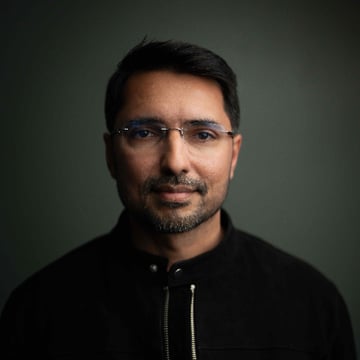
Drawing on our work on auth.md at WorkOS, I’ll show how to build that path: letting agents discover your service, establish identity, register, and receive the permissions they need to get started. We’ll explore agent-native onboarding built on existing standards, including how a person or organization can later claim the account. Engineering leaders will leave with a practical framework for opening their products to agents, not just as another integration to support, but as a new way to reach and serve customers.

+ content:video.read_more_button
Speakers:
user's Avatar
From2:30 PM
To3:00 PM
PDT
Tags:
Break
Break
From3:00 PM
To3:30 PM
PDT
Tags:
Presentation
Return On Token Spend: How Companies Finally Solved the Quantification Problem in Engineering

Engineering has always had a quantification problem: we could measure activity, but never truly connect investment to output. Ironically, AI agents are solving it. Tokens are metered, agent work is traceable end to end, and for the first time the inputs to engineering are as measurable as the outputs. This talk shows how leading companies are turning that visibility into a return-on-token-spend model: which productivity metrics hold up in agentic workflows, which quietly break, and how to tie token consumption to shipped outcomes. You'll leave with a framework you can implement with your existing tooling, and the numbers to answer the ROI question your CFO is already asking.

+ content:video.read_more_button
Speakers:
user's Avatar
From3:30 PM
To4:00 PM
PDT
Tags:
Fireside Chat
Flattening the AI cost curve at scale

Baseten is a hypergrowth company with an unusual trajectory. In the last 12 months alone, the increases in revenue, usage, and headcount have put Amir in a position that very few engineering leaders have had to face.

Join Amir and Corinne for a conversation covering:

  • Maintaining uptime, responsiveness, and reliability through hypergrowth
  • Landing teams well through acquisition
  • Choosing which problems to solve when engineering talent is stretched thin
  • Sustaining high retention in a high-growth environment
+ content:video.read_more_button
Speakers:
user's Avatar
user's Avatar

Venue Maps

Venue Map
Venue Floor Plan

Sponsors

Diamond
Gold
Silver
Community
Event has finished
8:00 AM PDT (Event time zone)
Oct 13 – Oct 14, 2026
Location
Location
Gateway Pavilion, Fort Mason Center, 2 Marina Blvd, San Francisco, CA, United States
Organized by
user's Avatar
ELC
Event has finished
8:00 AM PDT (Event time zone)
Oct 13 – Oct 14, 2026
Location
Location
Gateway Pavilion, Fort Mason Center, 2 Marina Blvd, San Francisco, CA, United States
Organized by
user's Avatar
ELC