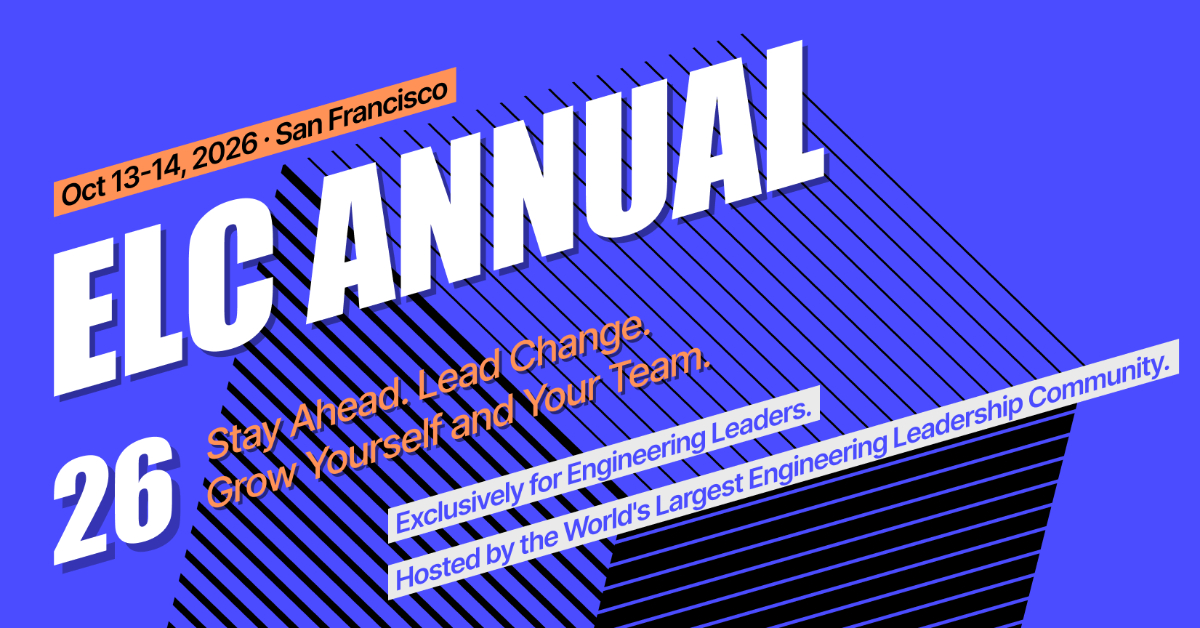
The ELC Annual is built around a simple belief: the most valuable learning happens in conversation - with peers who are navigating the same pressures, making the same hard calls, and building through the same uncertainty.
This year, we're going deeper on the questions that don't have easy answers.
What does it mean to lead well when the ground keeps shifting? How do you build teams that are resilient, high-trust, and genuinely high-performing, not just on paper? What does great engineering leadership look like beyond the technical, in the moments that require judgment, integrity, and clarity of purpose?
Across roundtable discussions, intimate speaking sessions, and 1:1 conversations, you'll engage with engineering leaders who are thinking seriously about these questions — and willing to share what they've actually learned.
—
What you'll explore
Leading through uncertainty and volatile decision-making environments. The evolving CTO/VP role — from roadmap owner to visionary strategist. Ethical decision-making, leadership integrity, and purpose-driven organizations. Storytelling and influence: communicating complex ideas to executives and boards.
Building high-trust teams and psychological safety at scale. Navigating culture shifts in growing organizations. Scaling hybrid and remote work — the practices and rituals that actually stick. Building inclusive engineering cultures and diverse talent pipelines.
- Talent & People Development
Developing next-generation leaders through mentoring and succession planning. Continuous performance management and feedback systems. Retention, engagement, and creating environments where people genuinely thrive. Hiring for potential: assessing soft skills and growth mindset.
- Cross-Functional Collaboration
Aligning engineering, product, and design around shared outcomes. Breaking down silos with tools and practices that work. Customer-centric engineering: building products users truly love. Cross-functional OKRs and collaborative planning across roadmaps and backlogs.
Building AI-enabled teams — what it looks like beyond the theory. AI in software development: coding assistants, prompt engineering, and human-AI collaboration. Translating AI trends into actionable engineering strategy. Architecting AI systems that make it to production and stay there.
Measuring developer productivity, satisfaction, and team health. Observability and incident response in AI-enabled systems. Balancing innovation with operational priorities. Coaching teams through change without losing momentum.
—
What to expect
Roundtable Discussions
Small-group sessions facilitated by experienced practitioners — designed for active participation, not passive listening. These are the conversations where people say what they actually think.
Speaking Sessions
Close-up conversations with engineering leaders who are actively shaping what the role looks like today. Past speakers have included leaders from OpenAI, Stripe, Google, Dropbox, Atlassian, and Slack, as well as Reid Hoffman, Max Levchin, and Adam Grant.
1:1 Meetings
Structured time to connect directly with peers, mentors, and industry veterans. Some of the most valuable relationships in ELC have started here.
—
Leave with a clearer sense of what kind of leader you want to be - and a network of people who are working toward the same thing.